Pinky Piggy Bank DIY 3D Papercraft: A Practical Evaluation for Makers
The intersection of functional savings tools and decorative home accents has long been a niche interest for crafters. Among the various options available, the Pinky Piggy Bank DIY 3D Papercraft stands out as a specific design solution that balances aesthetic appeal with structural utility. Unlike traditional ceramic banks or simple cardboard cutouts, this model utilizes a low-poly geometric style to create a durable, three-dimensional object from cardstock. For adults aged 20 to 50 who are evaluating papercraft projects for personal use, gifting, or interior styling, understanding the specific mechanics, assembly requirements, and comparative advantages of this design is essential before committing to the build.
Defining the Design: Low-Poly Geometry and Functionality
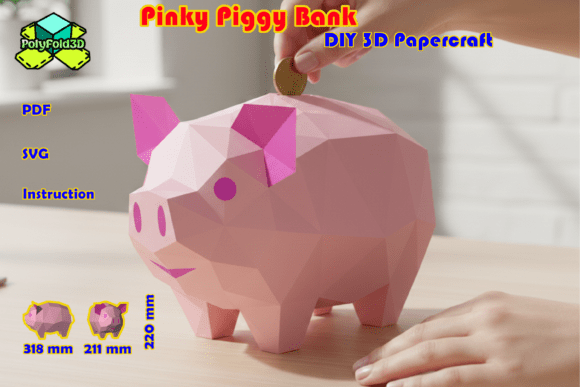
The Pinky Piggy Bank DIY 3D Papercraft is distinct primarily due to its architectural approach to a classic subject. Rather than attempting to replicate organic curves with complex folding, the design employs a low-poly technique. This method breaks down the pig's form into flat, angular facets that interlock to create volume. The result is a finished piece with a modern, stylized look that complements contemporary decor better than traditional cartoonish representations.
Functionality is a critical differentiator in this category. Many papercraft models prioritize visual impact over usability, often resulting in structures that cannot hold weight or have inaccessible interiors. The Pinky Piggy Bank design addresses this by incorporating a detachable coin access hole at the rear. This feature ensures the model serves its primary purpose as a savings vessel without requiring destructive disassembly to retrieve funds. The dimensions—measuring 318 mm in length, 211 mm in width, and 220 mm in height—provide a substantial presence on a desk or shelf while remaining manageable for indoor spaces.
Comparative Analysis: Paper vs. Traditional Materials
When considering a piggy bank, consumers typically weigh paper against ceramic, plastic, or metal. Each material presents a unique set of tradeoffs regarding cost, durability, and customization.
- Ceramic and Glass: These materials offer superior weight and permanence but lack modularity. Once broken, they are often unusable, and they cannot be customized in terms of color or size without significant expense.
- Plastic Injection Molded: While durable and cheap, plastic options often suffer from generic designs and environmental concerns regarding waste. They offer little opportunity for creative engagement during the creation process.
- Papercraft (The Pinky Model): The Pinky Piggy Bank DIY 3D Papercraft occupies a middle ground. It offers the tactile satisfaction of construction and the ability to customize colors (the design includes two color variations) without the fragility of glass or the environmental footprint of single-use plastics. However, it requires an investment of time and manual dexterity that pre-made options do not.
For those prioritizing a "set it and forget it" solution, a ceramic bank may be more practical. However, for individuals seeking a project that yields a unique, handmade result, the papercraft format provides a level of personalization that mass-produced items cannot match.
Evaluating the Assembly Process and Skill Requirements
A critical factor in choosing any DIY project is the alignment between the builder's skill level and the project's complexity. The Pinky Piggy Bank is categorized as Intermediate, suggesting that while basic papercraft experience is recommended, it is accessible to dedicated beginners willing to learn.
The model consists of 45 individual parts. This count is significant; it is higher than simple pop-up cards but lower than complex architectural models. The assembly process involves precise cutting, scoring, and gluing. The inclusion of clear, illustrated instruction PDFs helps mitigate the learning curve, guiding the user through the step-by-step construction. The design is optimized for stability, meaning that if instructions are followed accurately, the final structure will be robust enough to handle the weight of coins.
One must consider the tooling required. The project files include SVG formats for cutting machines (such as Cricut or Silhouette) and PDF templates for hand cutting. For users with electronic cutters, the production time is significantly reduced, making the project more efficient. Conversely, those relying on scissors and craft knives should allocate several hours for cutting alone, in addition to assembly time. This distinction is vital for decision-making: if speed is a priority, a cutting machine is almost a necessity for a high-quality finish on a 45-part model.
Material Considerations and Longevity
The longevity of the Pinky Piggy Bank DIY 3D Papercraft depends heavily on the substrate used. The design specifies cardstock paper, which provides the necessary rigidity to maintain the low-poly shape under the stress of coin accumulation. Using standard printer paper would likely result in a flimsy structure that collapses under minimal weight.
Cardstock thickness generally ranges from 65 lb to 110 lb. For this specific model, a medium-to-heavy weight cardstock is ideal. Too thin, and the edges will fray or bend; too thick, and the intricate folds may crack or fail to adhere properly. Additionally, the two-color variation option allows builders to mix and match tones, creating depth and shadow effects that enhance the low-poly aesthetic. This flexibility allows the creator to tailor the bank to specific room palettes, a feature unavailable in fixed-color commercial products.
Use Cases and Strategic Fit
Determining whether the Pinky Piggy Bank is the right choice requires analyzing the intended context of use.
Ideal Scenarios
- Educational Projects: For parents or educators looking to teach children about saving money and geometry, this model offers a hands-on way to visualize volume and structure.
- Custom Gifting: Because the item is handmade, it carries sentimental value that store-bought gifts lack. It is particularly suitable for birthdays or housewarmings where a personalized touch is desired.
- Decor Styling: The soft pink tones and geometric style fit well in nurseries, kids' rooms, or modern offices. It serves as a conversation starter rather than just a utility item.
Limitations and Alternatives
There are situations where this papercraft model may not be the optimal choice. If the environment is prone to high humidity or moisture, paper is inherently vulnerable compared to sealed ceramic or plastic. In such cases, the paper bank should be kept strictly indoors and away from windows or kitchens. Furthermore, if the user seeks a purely functional container with zero maintenance, a pre-assembled metal tin might be more appropriate. The Pinky Piggy Bank requires care; it should not be treated as a toy for rough handling.
File Formats and Workflow Integration
The technical resources provided with the Pinky Piggy Bank DIY 3D Papercraft play a significant role in the user experience. The inclusion of both SVG and PDF files caters to different workflows. SVG files allow for vector scaling, ensuring that the lines remain crisp regardless of the cutting machine settings. This is crucial for maintaining the integrity of the 45 pieces. The absence of DXF files at this time is a minor limitation for users of specific CAD software, but the SVG and PDF combination covers the vast majority of hobbyist needs.
The illustrated assembly guide is perhaps the most valuable component. Complex papercraft models can become frustrating without clear visual cues. A well-structured guide reduces the risk of errors during the gluing phase, which is often where projects fail. By following the sequence provided, builders can ensure that the load-bearing joints are reinforced correctly, leading to a stable final product.
Making the Decision
Ultimately, the decision to pursue the Pinky Piggy Bank DIY 3D Papercraft comes down to a balance between the desire for a custom, aesthetically pleasing object and the willingness to invest time in its creation. It is not merely a container for coins; it is a craft project that results in a functional art piece. For those who enjoy the process of building, the intermediate difficulty level offers a satisfying challenge without being insurmountable.
Compared to buying a generic bank, this option provides a deeper connection to the object and the ability to control every aspect of its appearance. Compared to other complex papercrafts, its focus on functionality—the removable back panel and sturdy dimensions—makes it a practical addition to a household. By weighing the material requirements, the time commitment for assembly, and the specific environmental conditions of the intended location, potential builders can determine if this design aligns with their goals. For the right audience, the Pinky Piggy Bank represents an excellent fusion of creativity, utility, and modern design.