3D Soccer Home Sign Custom Nameplate: A Practical Evaluation
In the realm of custom digital fabrication, few designs bridge the gap between technical precision and aesthetic appeal as effectively as the 3D Soccer Home Sign Custom Nameplate. This asset is not merely a graphic file; it is a structured blueprint engineered for laser cutting workflows. For makers, small business owners, and serious hobbyists looking to produce high-end sports decor, understanding the mechanics and potential of this specific design is essential. Unlike flat vector art that requires post-production assembly, this multi-layered approach offers a built-in solution for creating depth and texture directly from the machine.
The Architecture of Multi-Layered Design
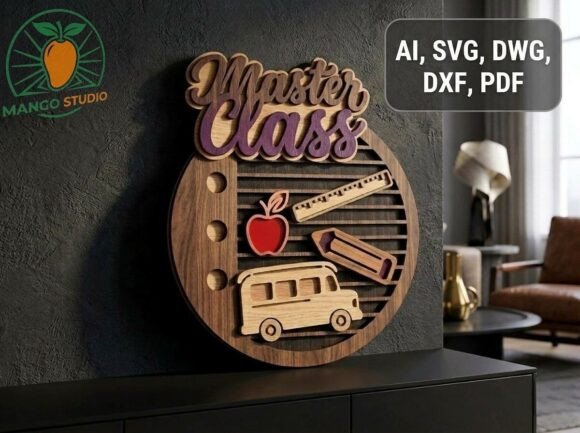
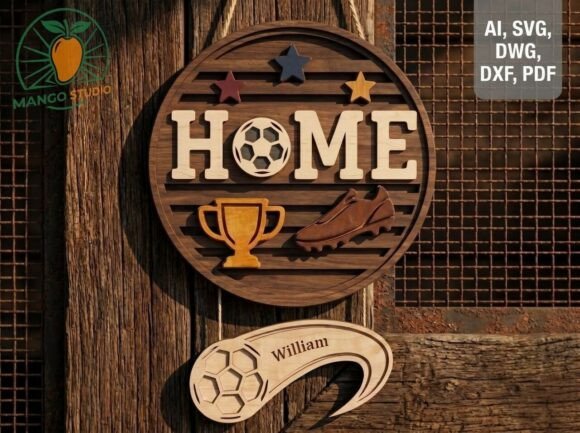
The primary value proposition of the 3D Soccer Home Sign Custom Nameplate lies in its construction. The design utilizes a unique slatted background within the "HOME" circle, creating an inlay effect that catches light differently than solid surfaces. When cut from materials like plywood, acrylic, or MDF, these slats allow for a flush-mounting technique where the soccer ball icon sits recessed or elevated relative to the background, depending on the material thickness and layering strategy.
This architectural choice addresses a common pain point in laser cutting: the tendency for simple 2D cuts to look flat and unremarkable when mounted on a wall. By incorporating distinct layers, the design achieves a professional relief effect without requiring complex CNC routing or manual carving. The detachable hanging nameplate at the bottom further enhances this utility. It separates the functional element—the player's name—from the decorative iconography, allowing for a modular approach to production. If you are running a shop that produces gifts for multiple families with different names but the same team preference, this modularity significantly streamlines your workflow.
Technical Precision and File Integrity
For professionals utilizing software such as LightBurn or Glowforge, the quality of the source vector files is paramount. The 3D Soccer Home Sign Custom Nameplate is delivered with clean, smooth paths optimized specifically for laser cutting machines. In practical testing scenarios, well-optimized paths reduce the likelihood of burn marks at intersection points and ensure that intricate details, such as the stitching on the soccer ball or the edges of the slats, remain crisp.
The package includes a comprehensive suite of formats: AI (Adobe Illustrator), SVG (Scalable Vector Graphics), DWG (AutoCAD), DXF (Drawing Exchange Format), and PDF. This variety is critical for compatibility across different hardware ecosystems. While SVG is often sufficient for consumer-grade lasers, industrial setups or those integrating CAD data may require the DWG or DXF formats. The inclusion of these diverse file types ensures that the design remains accessible regardless of the user's specific software stack. Furthermore, the scalability of these vector formats means the sign can be resized to fit various mounting spaces—from a compact nursery shelf to a large man cave feature—without the pixelation or loss of detail associated with raster images.
Material Selection and Fabrication Considerations
While the digital file provides the roadmap, the final outcome depends heavily on material selection. The layered nature of the 3D Soccer Home Sign Custom Nameplate suggests that materials with varying thicknesses will yield different visual results. For instance, using 3mm Baltic birch plywood allows for a subtle shadow line between layers, whereas 6mm or thicker acrylic can create a bold, three-dimensional pop.
Creators should consider the thermal properties of their chosen material. The slatted background, while visually striking, increases the total cut time due to the higher number of internal vectors. In dense woods, this may lead to charring if power and speed settings are not calibrated correctly. Conversely, acrylic benefits from the heat, often resulting in polished edges after the cut. The flush-mounted icons require precise nesting; if the kerf (the width of the laser beam) is not accounted for in the design setup, the ball icon might sit too loosely or too tightly within its designated slot. Users must adjust their offset settings in their cutting software to accommodate the specific blade width of their laser head.
Market Viability and Audience Fit
From a commercial perspective, this design targets a robust demographic: adults aged 20–50 who are invested in sports culture, home improvement, and personalized gifting. The "soccer" theme has global resonance, making the product viable in international markets. However, the specific execution of the "Home" concept appeals strongly to parents decorating nurseries for young athletes, fans upgrading their game-day viewing areas, or individuals seeking housewarming gifts that reflect personal identity.
For entrepreneurs and freelancers, the 3D Soccer Home Sign Custom Nameplate represents a low-risk inventory item. Since the product is digital-first, there is no upfront cost for physical stock. The variable cost is limited to the raw materials and machine runtime. The ability to customize the bottom plaque allows sellers to charge a premium for personalization, which is a standard expectation in the modern e-commerce landscape. Parents, in particular, are willing to pay extra for items that bear their child's name, transforming a generic decoration into a cherished keepsake.
Workflow Integration and Efficiency
Integrating this design into an existing production workflow requires minimal adjustment. Because the file structure separates the main sign from the nameplate, batch processing becomes feasible. A maker can cut fifty identical soccer signs and then run a separate job for fifty different names, optimizing bed space and reducing setup time. This separation also aids in error management; if a name is misspelled during the engraving phase, only that single plaque needs to be re-cut, rather than discarding the entire sign assembly.
However, the assembly process does introduce a step that must be managed. Unlike a single-piece cut, the multi-layered design requires gluing or mechanical fastening. For high-volume production, this could become a bottleneck if not organized efficiently. Using clamps designed for quick release or setting up a dedicated assembly station with UV-curing glue can mitigate this. The long-term durability of the sign will depend on the adhesive used and the environmental conditions of the display area. Indoor humidity fluctuations can cause wood to warp, potentially separating layers over time if the bond is weak.
Limitations and Realistic Expectations
While the 3D Soccer Home Sign Custom Nameplate is a powerful tool, it is not without limitations. The complexity of the slatted design means it is not suitable for very thin materials where structural integrity would be compromised by excessive cutting. Additionally, the aesthetic is distinctly sport-focused; it may not align with minimalist or non-sport-themed interior design schemes. Creators should also note that the "premium" look relies heavily on finish quality. Raw plywood edges can appear rough, necessitating sanding or staining to match the professional appearance suggested by the design.
Furthermore, the reliance on specific software formats means users must have access to compatible tools. While the provided formats cover most bases, some proprietary laser controllers may struggle with certain DXF versions or nested layers if not properly flattened or exported. Users should always perform a test cut on scrap material before committing to expensive substrates.
Conclusion on Utility and Value
The 3D Soccer Home Sign Custom Nameplate stands out as a resource that balances creative ambition with technical feasibility. Its strength lies in the thoughtful engineering of its layers, which solves the problem of flatness in laser-cut decor while offering a clear path to customization. For the serious hobbyist, it provides a satisfying challenge in material handling and assembly. For the professional, it offers a scalable product line with high perceived value.
Ultimately, the success of this project hinges on the creator's attention to detail in both the digital setup and the physical assembly. When executed correctly, the result is a durable, visually striking piece of decor that resonates with sports fans and serves as a testament to the capabilities of modern digital fabrication. Whether used for personal projects or commercial ventures, this design delivers consistent results, provided the user respects the nuances of laser cutting physics and material science.